Feast Where the Desert Meets the Sea: A Flavor Journey Along Namibia’s Skeleton Coast
You know that feeling when you taste something so unexpected, it rewires your senses? That’s exactly what happened on Namibia’s Skeleton Coast. Far beyond shipwrecks and dunes, this wild stretch hides a quiet culinary magic—where fresh seafood, local flavors, and desert-grown surprises come together. I didn’t expect fine dining in one of Earth’s most remote places, but here, under endless skies, I found soulful meals that tell stories of resilience, tradition, and the sea’s raw bounty. In a landscape shaped by wind, salt, and silence, food becomes more than sustenance; it transforms into a language of place, spoken through smoke, sea spray, and sun-baked earth.
The Unexpected Cuisine of an Unforgiving Coast
Namibia’s Skeleton Coast is not a place one associates with abundance. Stretching over 500 kilometers along the Atlantic, this arid frontier is defined by fog-draped dunes, skeletal whale bones, and the rusted hulls of century-old shipwrecks. Rainfall is rare, fertile soil almost nonexistent, and the very air carries a chill from the cold Benguela Current. Agriculture, as most understand it, is nearly impossible. Yet, in this stark environment, a unique food culture has emerged—one not born of luxury, but of necessity, patience, and deep respect for natural cycles.
Because farming is so limited, the people and communities along the coast have long relied on the sea and the few resilient plants that survive in the desert. This dependence has led to a cuisine that is both minimalist and profoundly expressive. Every ingredient carries weight; nothing is wasted. The isolation of the region—far from major urban centers and supply chains—has preserved traditional methods of preservation, preparation, and foraging. Smoking fish over driftwood, drying meat in arid winds, and fermenting wild plants are not culinary trends here; they are survival techniques refined over generations.
What makes this cuisine so remarkable is the contrast between the severity of the landscape and the richness of the flavors. At first glance, the coast appears barren, even hostile. But those who know where to look find life—hidden in tidal pools, clinging to rocky outcrops, or buried beneath the sand. The food reflects this duality: simple in form, yet layered with meaning. Meals are often quiet affairs, eaten slowly, with attention. There is no rush, no excess. Instead, there is presence—each bite a reminder of how much it takes to bring nourishment to such a remote edge of the world.
Seafood Straight from the Cold Atlantic
The Benguela Current, a deep upwelling of nutrient-rich waters from the ocean floor, is the lifeblood of the Skeleton Coast. It fuels one of the most productive marine ecosystems on the planet, supporting vast schools of fish, dense kelp forests, and thriving shellfish beds. For coastal communities and visiting travelers alike, the sea provides not just sustenance but a cornerstone of identity. The seafood here is unlike any other—clean, briny, and intensely fresh, pulled directly from icy waters with minimal handling.
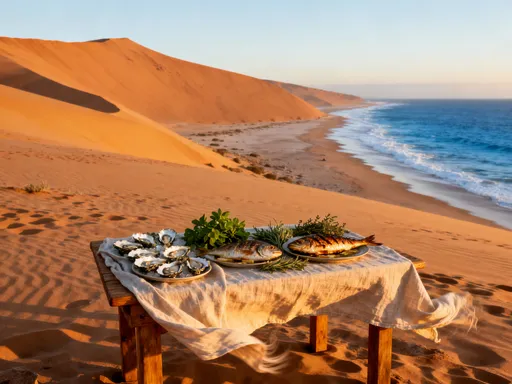
Among the most prized catches is the Cape rock lobster, known locally as “west coast rock lobster.” These crustaceans, with their deep red shells and sweet, firm flesh, are often grilled simply over open fires fueled by driftwood. The smoky aroma blends with the salty breeze, creating a sensory experience that lingers long after the meal ends. Oysters, too, are a delicacy, harvested from tidal zones and served raw on the half-shell with nothing more than a squeeze of lemon or a drop of chili oil. Their flavor is bold and metallic, a true taste of the cold Atlantic.
Fish such as kingklip and hake are commonly line-caught by small-scale fishers who follow sustainable practices passed down through families. Kingklip, with its delicate white flesh and buttery texture, is often pan-seared or baked with minimal seasoning to preserve its natural taste. Hake, more abundant and versatile, appears in stews, grilled fillets, or dried into bokkoms—a traditional fish jerky that keeps well in the dry climate. These preparations reflect a deep understanding of preservation and flavor balance, shaped by the need to make food last in a place where resupply is difficult.
Sustainability is not a buzzword here; it is a necessity. Overfishing has been a concern in parts of Namibia’s waters, leading to strict regulations and community-led management of marine resources. Many lodges and tour operators work directly with local cooperatives to source seafood responsibly, ensuring that harvesting remains within ecological limits. Travelers are encouraged to ask about the origin of their meals and to support practices that protect the long-term health of the coast’s fragile ecosystem.
Dining in the Wild: Campfire Feasts and Mobile Kitchens
On the Skeleton Coast, dining is rarely confined to a formal restaurant. Most culinary experiences unfold in remote desert camps, eco-lodges, or along secluded stretches of beach, where meals are prepared in mobile kitchens or over open fires. These settings transform eating into an immersive event—one that engages all the senses. The crackle of flames, the scent of wood smoke, the vastness of the night sky, and the rhythmic pulse of waves create a backdrop unlike any other.
Skilled camp cooks and traveling chefs play a vital role in these experiences. Often trained in both traditional and modern techniques, they carry compact pantries and portable stoves across rugged terrain, turning simple ingredients into refined dishes. A typical dinner might begin with a smoked fish pâté served on crispbread, followed by grilled line-caught fish with a herb crust made from foraged desert plants. Desserts are modest but satisfying—perhaps a spiced poached pear with cardamom, or a dark chocolate tart warmed over coals.
One unforgettable evening took place on a wide, windswept beach near the Hoanib River delta. As the sun dipped below the horizon, casting long shadows across the dunes, a table was set with linen, lanterns, and glassware—juxtaposed against the raw wilderness. Guests gathered around a central fire where skewers of marinated kingklip sizzled. The meal was served in courses, each paired with a carefully selected South African wine. There were no walls, no roof—just the open sky and the sound of the ocean. In that moment, dining felt elemental, almost sacred.
These outdoor feasts are not just about food; they are about connection—to the land, to fellow travelers, and to the rhythms of nature. The absence of distractions allows for deeper conversation and reflection. Eating under the stars, with sand beneath your feet and wind in your hair, shifts your relationship to food. It becomes an act of gratitude, a pause in the journey to honor the effort it took to create such a moment in such a place.
Local Flavors: From !Nara Melons to Desert Herbs
While the sea dominates the plate, the desert itself contributes subtle but essential flavors to the region’s cuisine. Among the most remarkable of these is the !Nara melon (Acanthosicyos horridus), a spiky, melon-like fruit that thrives in the shifting sands of the Namib. For the indigenous Topnaar people, the !Nara is a vital food source, its seeds rich in oil and protein, and its pulp mildly sweet and refreshing. Harvested in late summer, the fruit is eaten fresh, dried, or pressed into oil used in cooking and skin care.
In recent years, chefs working in eco-lodges have begun incorporating !Nara into their dishes, recognizing its cultural and nutritional value. It appears in chutneys, seed-crusted breads, and even desserts where its delicate flavor complements richer ingredients. The seeds, when roasted, have a nutty taste similar to sunflower or pumpkin seeds, making them a natural addition to salads or grain bowls. Their use is not just culinary—it’s a way of honoring the knowledge of desert-dwelling communities who have lived in harmony with this harsh environment for centuries.
Other desert plants also find their way into meals. Wild garlic, a slender green shoot that emerges after rare rains, adds a sharp, aromatic note to sauces and marinades. Saltbush, a hardy shrub that accumulates minerals from the soil, imparts a natural salinity to dishes and is often used as a seasoning or garnish. Desert thyme and camel thorn bark are occasionally used in teas or spice blends, offering earthy, slightly medicinal notes that ground the palate.
Foraging is done with care and respect. Guides who lead these efforts are often from local communities and possess deep ecological knowledge. They teach visitors how to identify edible plants, when to harvest, and how to leave enough behind for regeneration. This practice is not about novelty; it’s about continuity. By including these ingredients in meals, travelers participate in a tradition that predates modern agriculture—a way of eating that is rooted in place, season, and reciprocity.
Cultural Crossroads: German Roots and Coastal Traditions
Namibia’s culinary identity is shaped by a complex history, and the Skeleton Coast is no exception. During the late 19th and early 20th centuries, the region was part of German South-West Africa, and traces of that colonial influence remain in certain food traditions. Smoked sausages, rye bread, and stews with European seasoning profiles can still be found in some lodges and guesthouses, particularly in the more accessible southern parts of the coast.
Yet, these Germanic elements coexist with—and are increasingly balanced by—indigenous foodways. The Herero and Himba peoples, though more commonly associated with northern Namibia, have cultural ties to the broader region, and their culinary practices emphasize communal eating, slow cooking, and the use of local grains and meats. Dishes like oshifima (a stiff maize porridge) and epo (a steamed cornmeal dumpling) may not be daily fare on the coast, but their influence is felt in the emphasis on shared meals and simple, nourishing foods.
In contemporary coastal kitchens, there is a growing effort to harmonize these influences without erasing their distinct origins. A breakfast spread might include both German-style smoked ham and a !Nara seed dip served with homemade flatbread. A dinner might pair grilled hake with a side of fermented pumpkin or a lentil stew seasoned with desert herbs. The goal is not fusion for its own sake, but thoughtful integration—creating meals that reflect the layered history of the land while remaining true to its present.
This blending happens with sensitivity. Many operators consult with local elders and cultural advisors to ensure that traditional foods are represented respectfully. Recipes are shared with permission, and credit is given where it is due. In this way, dining becomes a form of cultural exchange—one that values authenticity over appropriation and honors the people who have stewarded these lands for generations.
Where to Eat: Lodges, Pop-Ups, and Hidden Stops
For travelers seeking these unique culinary experiences, the options are limited but exceptional. Due to the remoteness of the Skeleton Coast, there are no roadside diners or casual eateries. Instead, meals are typically arranged through guided tours or stays at eco-conscious lodges that prioritize both comfort and authenticity. One of the most renowned is Shipwreck Lodge, located in the Skeleton Coast National Park. Its isolated cabins resemble weathered ship hulls, and its kitchen focuses on seasonal, locally sourced ingredients prepared with care and creativity.
Other private tour operators offer mobile safari-style experiences, where guests are accompanied by a guide, chef, and support crew. These trips often include精心 prepared meals at temporary campsites, with menus designed to evolve based on what is available. Some operators even coordinate surprise pop-up dinners—perhaps on a deserted beach, in a ghost town like Cape Cross, or beneath a grove of ancient acacia trees. These events are kept secret until the day of, adding an element of wonder to the journey.
Because infrastructure is minimal, advance planning is essential. Most lodges require reservations months in advance, and dietary preferences or restrictions must be communicated early. Some operators can accommodate vegetarian or gluten-free diets, though options may be more limited due to supply constraints. Travelers are advised to bring supplemental snacks, especially on multi-day excursions, though the core meals provided are typically ample and satisfying.
For those on self-drive adventures, opportunities to eat are even rarer. A few remote rest camps and research stations may offer basic meals, but these are not guaranteed. The best approach is to travel with a well-stocked cooler and a spirit of flexibility. Even a simple meal—cold seafood, fresh bread, and a cup of tea—can feel luxurious when enjoyed in such a dramatic setting.
Why This Cuisine Stays With You
Long after leaving the Skeleton Coast, the meals linger in memory. Not because they were elaborate or extravagant, but because they were honest. Each dish carried the imprint of its origin—the salt of the sea, the dryness of the desert, the patience of the people who prepared it. Eating here is not a passive act; it is an invitation to witness resilience, to appreciate scarcity, and to taste the quiet strength of a place that asks much and gives carefully.
There is a purity to the food that comes from its context. Without the distractions of urban life, without the convenience of global supply chains, every ingredient must earn its place on the plate. This scarcity amplifies flavor. A single oyster, eaten on the shore where it was harvested, tastes more vivid than a dozen served in a city restaurant. A piece of bread baked over fire, dusted with !Nara seeds, feels like a gift. The remoteness heightens awareness; you notice the texture, the temperature, the silence that follows each bite.
But more than that, the cuisine tells a story. It speaks of adaptation, of generations learning to thrive in one of the world’s most extreme environments. It honors the sea that feeds, the desert that sustains, and the cultures that have lived in balance with both. To eat on the Skeleton Coast is to participate in that story, even if only for a meal. It is to understand that food is not just fuel—it is memory, identity, and connection.
For the traveler, this is a reminder: the deepest experiences are not always the loudest. They are found in stillness, in simplicity, in the quiet moments when flavor becomes feeling. So when you plan your journey to Namibia’s wild coast, don’t just pack your camera—bring your curiosity, your respect, and your appetite for stories told through taste. Seek not only the sights, but the flavors that reveal a place’s soul. Because here, where the desert meets the sea, every meal is a revelation.