Through the Lens of Tradition: Chasing Culture in Almaty’s Hidden Corners
Almaty, Kazakhstan’s cultural heartbeat, isn’t just about snow-capped peaks or apple orchards—it’s a living canvas of traditions waiting to be captured. As a traveler with camera in hand, I discovered that the city’s true magic lies in its people, rituals, and quiet moments often missed by the casual eye. This is where every frame tells a story deeper than scenery. From the murmur of elders sharing tales in leafy parks to the golden glow of hand-embroidered textiles in sunlit market stalls, Almaty invites photographers not merely to observe, but to connect. The most lasting images are not those of perfect symmetry or ideal light, but of genuine human experience—of laughter lines etched by time, of hands shaping dough for samsa, of children learning ancestral songs. In this journey through Almaty’s cultural soul, we explore how to see, respect, and preserve these fleeting yet profound moments through the lens.
Framing Almaty: Why Culture Makes the Best Photos
Travel photography often begins with grand vistas—towering mountains, sweeping valleys, and city skylines at golden hour. But in Almaty, the most compelling images emerge not from postcard panoramas, but from the intimate fabric of daily life. A woman adjusting her traditional silk scarf before entering a neighborhood mosque, a street musician tuning his dombra near Republic Square, or a vendor arranging pyramids of dried apricots at the Green Bazaar—these are the moments that breathe authenticity into a photo album. Cultural photography, when done with intention, transforms snapshots into narratives. It’s not about capturing perfection, but about preserving presence.
What sets cultural photography apart is its emotional resonance. A well-composed portrait of an elder in a woolen hat, eyes crinkled with warmth, speaks volumes about resilience, heritage, and belonging. These images endure because they reflect shared humanity. Unlike staged scenes or tourist performances, candid cultural moments offer unfiltered access to a community’s rhythm. To photograph them, however, requires more than technical skill. It demands patience, humility, and a willingness to slow down. The best photographs in Almaty are often taken after minutes—or even hours—of quiet observation, waiting for the right gesture, the unguarded smile, the fleeting glance that reveals character.
Respect is the cornerstone of meaningful cultural photography. This means understanding when not to raise the camera, when to lower it, and when to simply be present. In Almaty, where hospitality is deeply rooted in tradition, people often welcome curiosity—but always on their terms. Approaching with a smile, making eye contact, and asking permission in simple Russian or Kazakh phrases like “Bolashaqa bolama?” (May I take a photo?) builds trust. When that trust is established, the resulting images carry a truth that no filter or editing can replicate. The camera becomes not a tool of extraction, but of connection.
The Old Soul of Zhetysu: Almaty’s Cultural Roots
To photograph Almaty with depth, one must first understand the layers of history that shape its cultural identity. Nestled in the Zhetysu region, meaning “Seven Rivers,” the city sits at a crossroads of civilizations. For centuries, nomadic Turkic tribes roamed these fertile valleys, herding livestock and preserving oral traditions through epic poems and songs. Their legacy lives on in the Kazakh language, the reverence for horses, and the art of storytelling. Even today, elders gather in parks to recount tales of bravery and wisdom, their voices carrying echoes of a time when history was passed down by word, not written page.
The Soviet era brought sweeping changes—urbanization, industrialization, and new architectural forms. Yet, despite decades of centralized rule, Kazakh traditions persisted, often in quiet, resilient ways. Women continued to embroider intricate patterns onto clothing, families upheld the ritual of sharing tea from a shared bowl, and musicians played the dombra in private homes. After independence in 1991, there was a cultural renaissance. Traditional dress, music, and customs were not only preserved but proudly reclaimed. This blend of endurance and revival gives Almaty its unique character—a city that honors its past while moving forward.
Architecture in Almaty reflects this duality. Near the bustling Panfilov Street, wooden houses from the late 19th century stand beside Soviet-era apartment blocks and modern glass towers. Some of these old wooden homes, with their carved eaves and bright shutters, were built by Russian settlers, yet now serve as cafes or art studios where Kazakh artisans display felted carpets and silver jewelry. The city’s cultural institutions, like the Abay Opera House and the Museum of Folk Musical Instruments, further testify to this synthesis. To photograph these spaces is to document not just aesthetics, but identity—how a people remember, adapt, and express themselves through time.
Must-Visit Cultural Hotspots with Photographic Potential
For the culturally curious photographer, Almaty offers a wealth of authentic, unscripted moments. The Green Bazaar, or Zelyony Bazaar, is perhaps the richest in sensory detail. Open since the 1930s, it remains a hub of daily life where farmers, artisans, and families converge. Stalls overflow with dried herbs, wild honey, wheels of pungent kurt (dried cheese), and mountains of fresh produce. The air hums with bartering, the sizzle of meat in outdoor grills, and the rhythmic chopping of knives on wooden boards. This is not a tourist market—it’s a living economy, and it rewards the patient photographer with scenes of genuine interaction.
One can spend hours capturing the textures of daily trade: the weave of a hand-knotted carpet, the glint of sunlight on copper samovars, the flour-dusted hands of a baker pulling steaming samsa from a tandoor oven. The faces here tell stories of labor, pride, and community. A grandmother selecting apples for her grandchildren, a butcher wrapping meat in brown paper, a young couple sampling fresh ayran—these are the moments that define Almaty’s rhythm. Early morning is the ideal time to visit, when the light slants through the market’s arched roof and the energy is brisk but not overwhelming.
Another essential stop is the Central State Museum, where history unfolds through artifacts, photographs, and traditional costumes. The exhibits on ancient Saka warriors, with their gold-embroidered clothing and horse burials, provide context for the enduring importance of horsemanship in Kazakh culture. The museum’s dioramas of yurt life and seasonal migrations offer insight into the nomadic roots that still influence modern identity. While photography inside may be restricted in certain areas, the courtyard and exterior architecture—featuring traditional Kazakh motifs in stone and metal—offer strong visual opportunities.
Kok Tobe Hill, accessible by cable car or a steady climb, presents a different kind of cultural scene. Locals come here not just for the panoramic city views, but for leisure—families picnic, couples stroll, and children ride the old-fashioned carousel. The hilltop park, with its Soviet-era monument and open-air stages, hosts impromptu music performances, especially in summer. Photographers can capture the joy of ordinary recreation, framed against the backdrop of the Tien Shan mountains. Unlike more commercialized viewpoints, Kok Tobe retains a local, unpolished charm that makes it ideal for authentic street photography.
Capturing Traditions in Motion: Festivals and Daily Rhythms
While Almaty’s daily life offers rich photographic material, its seasonal festivals provide even deeper access to cultural expression. The most significant of these is Nauryz, the Central Asian New Year celebrated on March 21. Marking the spring equinox, Nauryz is a time of renewal, reconciliation, and communal feasting. In the days leading up to it, families prepare nauryz kozhe, a symbolic soup made with seven ingredients representing abundance and unity. Public squares fill with music, dance, and traditional games, including kokpar—a horseback sport where teams compete to carry a goat carcass to a goal.
For photographers, Nauryz is a vibrant tapestry of color, movement, and emotion. Women wear bright silk dresses with elaborate headdresses, men play dombra in circles, and children parade in miniature traditional attire. The atmosphere is celebratory yet intimate, rooted in generations of custom. To capture it authentically, timing is essential. Arriving early allows one to photograph preparations—the hanging of festive banners, the setting up of food stalls, the tuning of instruments. These behind-the-scenes moments often yield the most compelling images, revealing the care and pride that go into the celebration.
Beyond Nauryz, smaller events take place in nearby villages, where traditions are often practiced with greater intensity. In settlements like Issyk or Talgar, one might witness eagle hunting demonstrations, felt-making workshops, or wedding ceremonies featuring the ceremonial transfer of the bride’s headdress. These events are not staged for tourists; they are lived experiences. To attend them, travelers are advised to go through reputable cultural tour operators who coordinate with local communities. This ensures respectful access and supports the preservation of these customs.
Photographing festivals requires a balance between immersion and discretion. While wide-angle shots capture the energy of a crowd, close-ups reveal individual expressions—the concentration of a musician, the joy of a dancer, the solemnity of an elder offering a blessing. It’s important to avoid intrusive behavior, such as blocking views or disrupting rituals. When in doubt, stand back, observe, and wait for the moment to unfold naturally. The best festival photos are those that feel inclusive, as if the viewer is part of the celebration, not just a spectator.
People, Not Props: Ethical Photography in Cultural Spaces
One of the greatest responsibilities of the cultural photographer is to treat people with dignity. In Almaty, as in any place rich in tradition, it is tempting to see every elder, every artisan, every child in traditional dress as a potential subject. But reducing people to visual elements—props in a composition—undermines the very humanity that makes the images powerful. Ethical photography means recognizing that every person has the right to control how they are represented.
The simplest and most effective way to honor this principle is to ask. A smile, a gesture toward the camera, and a polite question in Russian (“Razreshite sdelat' foto?”) or Kazakh (“Sürötke ruqsat alama?”) goes a long way. In many cases, people will agree, especially if they sense genuine interest. Some may even invite you to sit, share tea, or explain what they are doing. These interactions often lead to the most meaningful photographs—not because of perfect exposure or framing, but because they are born of mutual respect.
When photographing children, extra care is needed. Always seek permission from a parent or guardian. Avoid photographing kids in vulnerable situations, such as begging or working in hazardous conditions. If a subject seems uncomfortable or turns away, lower the camera immediately. Respect is not negotiable. Using a zoom lens can help maintain distance while still capturing detail, allowing for candid shots without intrusion. However, even with technical tools, intention matters most. The goal is not to capture a moment at any cost, but to do so in a way that honors the subject.
Another ethical practice is to offer to share the photos. With a simple device like a tablet or smartphone, one can show the image immediately and, if possible, send a copy later. In some cases, printing a photo and returning it days later—especially during longer stays—can build lasting goodwill. This gesture transforms photography from a one-sided act into a shared exchange. It reminds us that behind every lens is a person, and behind every subject is a life worth honoring.
From Snapshots to Stories: Composing Meaningful Frames
Technical proficiency enhances cultural photography, but it is storytelling that gives it soul. In Almaty, where every street corner holds a potential narrative, composition becomes a tool for meaning. Consider the artisan shaping a wooden saddle in a workshop near the Central Mosque. A wide shot shows the cluttered space, the tools on the wall, the sunlight through a dusty window. A tighter frame focuses on his hands—gnarled, skilled, moving with precision. A third image captures his face as he looks up, smiling. Together, these frames form a story of craft, continuity, and pride.
Photographers can use visual techniques to deepen narrative impact. Framing a subject through a doorway or window creates layers, suggesting the idea of looking into another world. Reflections in shop windows or tea glasses can add symbolism—showing both the person and their environment in a single image. Shooting from a low angle during a felt-making demonstration emphasizes the physical effort involved, while a high vantage point in the market reveals the organized chaos of trade.
Another powerful approach is to create photo series rather than isolated images. Documenting the process of baking samsa—from dough preparation to oven insertion to final sale—tells a fuller story than a single shot of the finished product. Similarly, following a family through a day at Nauryz, from morning preparations to evening dances, preserves the rhythm of the celebration. When reviewing images later, these sequences often resonate more deeply than standalone shots.
Whenever possible, seeking feedback from locals can refine one’s perspective. Showing photos to a guide, host, or acquaintance and asking, “What do you see in this?” can reveal meanings that were initially missed. A gesture that seemed casual might carry cultural significance; a pattern on a dress might represent a family lineage. This collaborative approach not only improves the work but fosters connection across cultures.
Beyond Almaty: Extending the Cultural Lens to Nearby Villages
While Almaty offers abundant cultural experiences, the surrounding countryside provides even more immersive opportunities. Just an hour’s drive from the city, villages in the foothills of the Tien Shan Mountains maintain traditions with greater visibility. In places like Satbayev or Qonayev, life moves at a slower pace, shaped by the seasons and the land. Here, families still live in private homes with courtyards, raise livestock, and gather for communal meals.
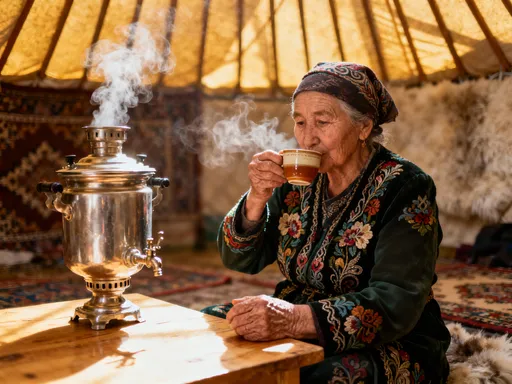
One of the most rewarding experiences is visiting a family in a traditional yurt, even if temporarily set up for cultural education. Inside, the space is warm and intimate, with colorful rugs, embroidered cushions, and a central stove. Sharing tea—a ritual in itself—opens the door to conversation. The host may play the dombra, sing a folk song, or demonstrate how to make kumis, fermented mare’s milk. These moments, when captured with permission, offer profound insights into Kazakh hospitality and daily life.
Other villages host workshops in traditional crafts. In some, women demonstrate how to make shyrdak, a felted carpet created by layering and stamping wool. The process is labor-intensive, passed down from mother to daughter. Photographing each step—the shearing of sheep, the dyeing of wool, the rhythmic pounding of layers—creates a visual archive of cultural knowledge. Similarly, observing a blacksmith shaping metal for horse gear or a weaver using a wooden loom connects the present to centuries of practice.
To visit these areas respectfully, travelers should consider guided cultural tours or homestay programs. These ensure that visits are welcomed by the community and that economic benefits go directly to local families. They also provide context—guides can explain customs, translate conversations, and help navigate cultural nuances. The contrast between urban Almaty and rural life enriches the photographer’s understanding, revealing how tradition adapts across environments.
Closing the Frame: Why Cultural Photos Stay With You
In an age of digital overload, where thousands of images are taken and forgotten each day, cultural photography stands apart. The photos that endure are not those with the most likes, but those with the most meaning. A portrait of an Almaty grandmother holding a teacup, her eyes reflecting a lifetime of stories, stays with you. A child laughing during a Nauryz dance, her embroidered dress catching the sunlight, becomes a cherished memory. These images are not souvenirs—they are records of connection, of moments when the lens bridged worlds.
Travelers are invited to explore Almaty not as passive observers, but as respectful witnesses. To seek depth over spectacle, relationship over exposure, and understanding over convenience. The city’s culture is not a backdrop for photography—it is a living, breathing presence that deserves honor. When we approach it with curiosity, humility, and care, our cameras become tools of preservation, not just documentation.
So go beyond the postcard views. Wander into the market at dawn. Sit in a park and listen. Ask permission. Share a smile. Let the story unfold. In the quiet corners of Almaty, where tradition lives in everyday gestures, the most powerful photographs are waiting—not to be taken, but to be given.