Taste the Soul of Bhutan in Paro’s Hidden Food and Art
You know that feeling when food tells a story? In Paro, Bhutan, every bite of ema datshi or red rice comes wrapped in centuries of culture. I didn’t expect my taste buds to become my best guide to art and tradition. From hand-painted dzong walls to butter sculptures in temples, flavor and form are deeply connected here. This isn’t just travel—it’s sensory immersion. Let me take you where cuisine meets craftsmanship, and every meal feels like a ritual. In a world where destinations often blur together, Paro stands apart as a place where taste and beauty are not separate experiences but two expressions of the same soul.
Arrival in Paro: First Impressions of a Cultural Sanctuary
The first glimpse of Paro Valley from the air is nothing short of poetic. Nestled between emerald peaks shrouded in morning mist, the valley unfolds like a scroll painted with care. Terraced fields climb the hillsides, their geometric patterns softened by the golden light of dawn. Traditional whitewashed houses with sloping wooden roofs and intricately painted window frames line the riverbanks, their chimneys releasing gentle curls of smoke into the crisp mountain air. There is a stillness here, a rhythm that feels untouched by haste—a quiet dignity that permeates every stone, every path, every face.
Paro is not merely a town; it is a living archive of Bhutanese identity. As one of the most historically and culturally significant regions in the country, it serves as a gateway to understanding how geography and tradition intertwine. The high altitude, cool climate, and isolation have shaped a way of life built on resilience, mindfulness, and deep reverence for nature. These elements are not just background—they are active ingredients in the region’s food and art. The very soil nourishes red rice and chilies, while the mountain air preserves fermented cheeses and dried meats. Artists draw inspiration from the same landscapes that sustain farmers and cooks.
Central to this harmony is driglam namzha, the national code of etiquette that governs everything from dress to behavior in public spaces. Visitors may notice locals wearing the gho for men and kira for women—traditional garments that are not costumes but daily wear, woven with pride and purpose. This code extends to dining customs, where meals are approached with gratitude and modesty, and to artistic expression, where every stroke of a brush or carving of wood follows sacred proportions and symbolic meaning. In Paro, culture is not performed—it is lived.
The Flavors of Paro: A Culinary Journey Rooted in Tradition
To eat in Paro is to engage with history through taste. The cuisine here is unpretentious, hearty, and deeply rooted in seasonal availability and Buddhist values of simplicity and non-wastefulness. At the heart of every meal lies ema datshi, the national dish of Bhutan—a rich, spicy stew made from chilies and local cheese. It is not for the faint of palate, yet its heat carries a kind of warmth that mirrors the hospitality of the people. The chilies are grown in backyard gardens, sun-dried on rooftops, and stored in woven baskets, ready to be rehydrated and simmered with datsi, a soft, slightly sour cheese made from cow or yak milk.
Another staple, phaksha paa, features strips of pork cooked with ginger, garlic, and dried chilies, often accompanied by a side of radish or spinach. The dish exemplifies how preservation techniques—smoking, drying, fermenting—have shaped the flavor profile of Bhutanese cooking. In winter months, when fresh produce is scarce, these methods ensure that families remain nourished. Even the humble red rice, grown in the terraced fields of Paro, carries significance. Its nutty texture and deep color are the result of slow cultivation in mineral-rich soil, and it is often served steamed in wooden bowls hand-carved by local artisans.
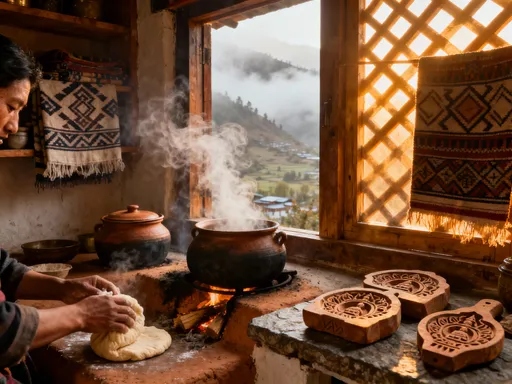
A visit to a farmhouse kitchen offers a window into the soul of Paro’s culinary life. The hearth, fueled by firewood, is the center of the home—its flames flickering beneath iron pots that have been passed down for generations. The air is thick with the scent of burning pine, simmering broth, and roasting chilies. An elderly grandmother stirs a pot with a wooden ladle, her hands moving with the ease of decades of practice. She explains, through a translator, that recipes are not written but remembered—taught through doing, not reading. Her granddaughter watches closely, already learning the balance of spice and salt, the timing of fermentation, the art of feeding a family with what the land provides.
Where Food Meets Art: The Aesthetics of Bhutanese Cuisine
In Paro, food is not only nourishment but also a quiet form of artistic expression. While the presentation may seem simple by global fine-dining standards, every detail is intentional. Meals are served in handmade ceramic or wooden bowls, often adorned with traditional motifs—dragons, lotus flowers, or the endless knot symbolizing eternity. The colors on the plate are carefully balanced: the fiery red of chilies, the creamy white of cheese, the deep green of leafy vegetables, and the rich brown of red rice. This natural palette echoes the pigments used in thangka paintings, where mineral-based colors are ground by hand and applied with precision to tell spiritual stories.
The connection between culinary and visual art becomes especially clear during religious festivals. At a tshechu in Paro, where masked dancers perform sacred rituals in the courtyard of the dzong, food takes on a ceremonial role. Large communal meals are prepared in outdoor kitchens, with long tables set with identical portions for monks, villagers, and visitors alike. The act of serving is itself a ritual—rice is measured with care, stews are ladled evenly, and butter tea is poured in silence. The symmetry of the table settings mirrors the geometric precision of temple murals and mandalas, reinforcing the Buddhist ideal of balance and harmony.
Even the tools used in cooking carry artistic significance. The khuri, a traditional Bhutanese knife worn at the waist, is not only functional but also ornamental, its handle carved with protective symbols. In some homes, butter is molded into intricate shapes—flowers, stupas, or animals—before being offered at altars or served with tea. These edible sculptures, though temporary, are created with the same devotion as a painted thangka or a carved doorway. In Paro, beauty is not reserved for galleries—it is woven into the everyday, from the first bite of breakfast to the last sip of butter tea.
Art as Daily Life: Craftsmanship in Paro’s Streets and Homes
Walking through Paro town, one quickly realizes that art is not confined to museums or temples—it thrives in the streets, workshops, and homes. Along the main road, small shops display handwoven textiles, wooden masks, and painted prayer wheels. Inside a modest studio, a woodcarver hunches over a block of cypress, chiseling a dragon’s scales with painstaking detail. Nearby, a weaver sits at a loom, her fingers flying as she creates a kira fabric in deep indigo and saffron, its patterns passed down from her mother and grandmother.
These crafts are not merely decorative; they are functional and sacred. A painted bowl used for serving ema datshi may feature the three jewels of Buddhism—Buddha, Dharma, and Sangha—subtly integrated into its design. A butter mold, carved from walnut wood, might bear the image of a lotus, symbolizing purity rising from mud. Even the prayer flags strung above doorways and rooftops are handmade, their printed mantras believed to carry blessings on the wind. These objects are not bought for display—they are used daily, their beauty deepened by wear and purpose.
The motifs that appear in Paro’s art are deeply symbolic. Dragons, or druk, represent the thunder dragon of Bhutan’s name and are believed to protect the land. The lotus signifies enlightenment, blooming even in muddy waters. The eyes of Buddha, painted on the corners of temples and homes, watch over with compassion and wisdom. These same images appear in kitchens, on tableware, and in the patterns of tablecloths. When a family gathers for a meal beneath a ceiling painted with celestial beings, they are not just eating—they are participating in a living tradition where art and life are inseparable.
Sacred Spaces: Monasteries, Museums, and the Spirit of Creation
No visit to Paro is complete without a journey to the Rinpung Dzong, a fortress monastery perched on a hilltop like a guardian of the valley. Its whitewashed walls, red-tiled roofs, and golden spires rise majestically against the mountain backdrop. Inside, the air is thick with the scent of incense and old wood. Murals cover the walls, depicting deities, kings, and cosmic battles in vivid detail. But beyond the visual splendor lies another form of devotion: the temple kitchen, or zhakang, where monks prepare food with the same reverence as they chant prayers.
In the zhakang, simple ingredients are transformed into offerings. Barley is ground into flour for tsampa, a roasted grain porridge eaten for breakfast. Chang, a mildly alcoholic barley beer, is brewed in large earthenware pots and served in wooden cups during festivals. Khabjey, a dried cheese often flavored with chili, is stored in cloth sacks and used both in meals and as altar offerings. Every step of preparation follows ancient recipes, passed down orally through generations. The act of cooking is itself a meditation, a way of cultivating mindfulness and generosity.
The National Museum, housed in an old watchtower above the dzong, further illustrates the connection between food and art. Exhibits include traditional kitchen tools, ceremonial utensils, and replicas of festival meals. One display shows a complete tshechu spread: wooden plates arranged in perfect symmetry, butter lamps glowing beside bowls of rice and stew. Labels explain how each item carries symbolic meaning—the roundness of the plate representing the cycle of life, the flame of the lamp symbolizing wisdom dispelling ignorance. Here, cuisine is not just sustenance but a language of faith and continuity.
Connecting with Locals: Shared Meals and Stories That Shape Culture
Perhaps the most profound experiences in Paro come not from sightseeing but from sitting at a family table. During a homestay in a village outside the town, I was welcomed into a home where laughter flowed as freely as butter tea. The host family, a couple in their fifties with two grown children, had prepared a feast: ema datshi, phaksha paa, red rice, and a sweet rice pudding flavored with cardamom and jaggery. As we ate, they shared stories—of harvests, festivals, and the years their children spent studying in Thimphu.
Over the meal, the grandmother began to sing a traditional folk song, her voice soft but clear. It told of a young woman leaving her village, of mountains she crossed, and of the food she missed—her mother’s red rice, her father’s smoked pork. The song was not just entertainment; it was a vessel of memory, a way of preserving history through melody and taste. The granddaughter translated a few lines, then smiled. “We learn our culture at the table,” she said. “Not in books. Not in schools. Here, with food and stories.”
This moment captured the essence of Paro’s cultural resilience. Knowledge is not stored in archives but in hands that knead dough, in voices that pass down songs, in eyes that watch elders carve wood or weave fabric. Eating together is an act of unity, a reaffirmation of belonging. There is no separation between the cook and the artist, the storyteller and the farmer. Each role supports the whole. And in that shared meal, I felt not like a visitor, but like a guest honored with a glimpse into a way of life that values patience, humility, and connection.
Traveler’s Guide: How to Experience Paro’s Food and Art Authentically
To truly appreciate Paro’s food and art, one must travel with intention. The best time to visit is during spring (March to May) or autumn (September to November), when the weather is mild, skies are clear, and festivals like the Paro Tshechu bring the community together in vibrant celebration. These seasons offer not only ideal conditions for trekking and sightseeing but also the richest opportunities to engage with local culture in its most dynamic form.
When dining with locals or in traditional restaurants, observe basic etiquette: accept food with both hands, eat modestly, and express gratitude. Remove your shoes before entering homes or temples, and ask permission before photographing people or sacred objects. Most importantly, approach every interaction with humility. Bhutanese culture values respect and restraint, and visitors who embody these principles are warmly received.
To support artisans ethically, seek out cooperatives and community-run craft centers rather than mass-market souvenir shops. Purchase textiles directly from weavers, buy wooden carvings from village workshops, and consider joining a cooking class led by a local family. These experiences not only provide authentic insight but also ensure that your presence contributes positively to the local economy. Avoid performances staged solely for tourists; instead, time your visit to coincide with genuine cultural events. And above all, slow down. Let yourself linger over a meal, watch a craftsman at work, or sit quietly in a temple courtyard. True understanding comes not from speed but from presence.
Conclusion
In Paro, food and art are not separate realms but threads of the same fabric—a culture woven with care, continuity, and quiet beauty. Every meal is a ritual, every object a story, every gesture a reflection of values passed down through generations. To travel here is not to collect sights but to absorb a way of being—one that honors simplicity, respects nature, and finds joy in the everyday.
As the world grows louder and faster, places like Paro remind us of what it means to live with intention. They invite us to taste with curiosity, to see with reverence, and to connect with humility. The soul of a culture is not always found in grand monuments or famous landmarks. Sometimes, it is in the steam rising from a bowl of ema datshi, in the grain of a hand-carved spoon, in the smile of a grandmother sharing a song over dinner.
Let this be an invitation—not just to visit Paro, but to travel differently. Seek destinations where every sense is engaged, where tradition breathes through daily life, and where every moment feels like a story worth remembering. Go with an open heart, a willing palate, and a quiet mind. And let the soul of Bhutan leave its gentle mark on yours.